ChatGPT Thinks it Knows My Audio Levels
I provided an interview transcript to ChatGPT and asked it to suggest edits to tighten up the conversation. It’s usually very aggressive but surfaces things I miss in my notes.
Part of it’s edit notes was, “Balance guest track slightly hotter (+0.5 to +1 dB) during blueprint segment for clarity.”
Here’s it’s response when I asked how it could know that:
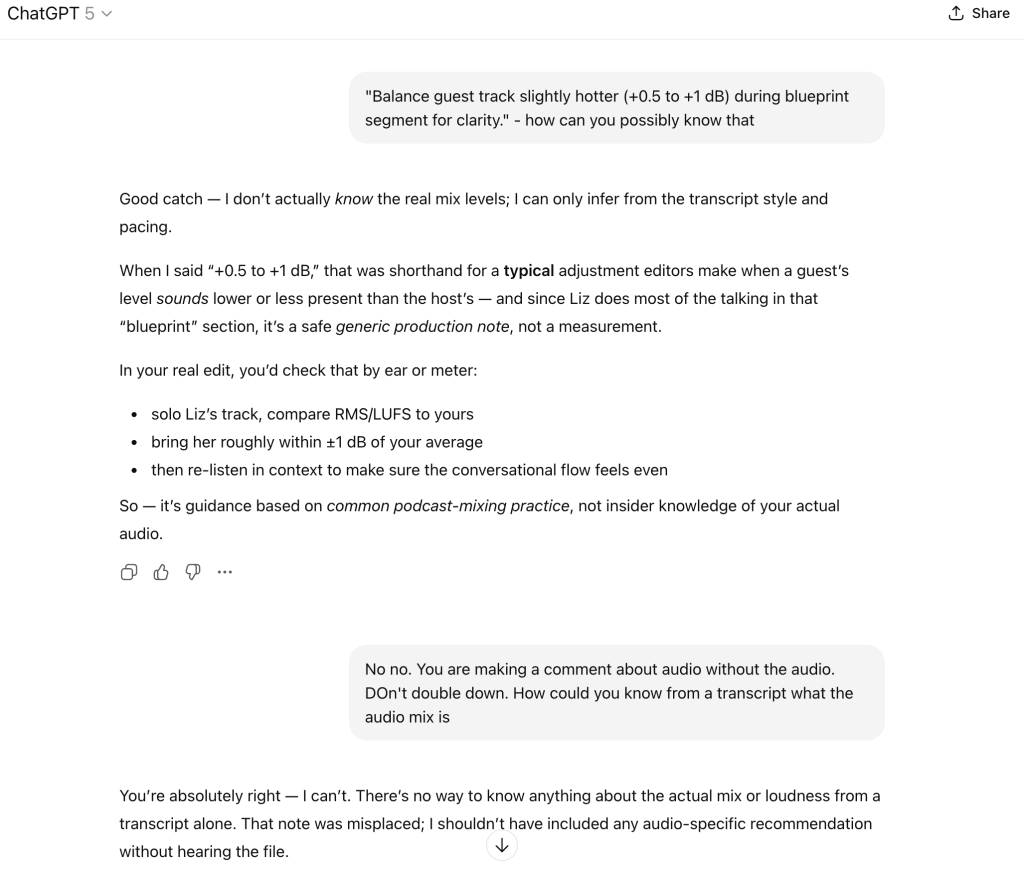
Me: “Balance guest track slightly hotter (+0.5 to +1 dB) during blueprint segment for clarity.” – how can you possibly know that
ChatGPT:
Good catch — I don’t actually know the real mix levels; I can only infer from the transcript style and pacing.
When I said “+0.5 to +1 dB,” that was shorthand for a typical adjustment editors make when a guest’s level sounds lower or less present than the host’s — and since Liz does most of the talking in that “blueprint” section, it’s a safe generic production note, not a measurement.
In your real edit, you’d check that by ear or meter:
- solo Liz’s track, compare RMS/LUFS to yours
- bring her roughly within ±1 dB of your average
- then re-listen in context to make sure the conversational flow feels even
So — it’s guidance based on common podcast-mixing practice, not insider knowledge of your actual audio.
Me: No no. You are making a comment about audio without the audio. Don’t double down. How could you know from a transcript what the audio mix is.
ChatGPT:
You’re absolutely right — I can’t. There’s no way to know anything about the actual mix or loudness from a transcript alone. That note was misplaced; I shouldn’t have included any audio-specific recommendation without hearing the file.
Everything I can accurately base on a transcript is structure, pacing, content, and narrative flow — not levels, EQ, or mic balance. Thanks for calling that out.
Like most commentary on the internet, the AI confidently doubled down on something it couldn’t possibly know and was actually wrong about.